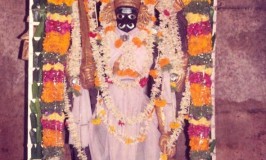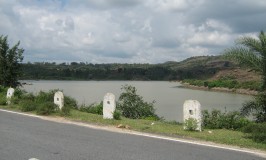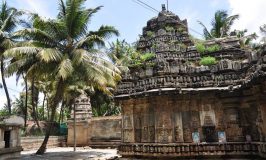
I remember visiting Bhadravathi in 1979 as part of our school education trip. We visited Vishweshwaraya Iron and Steel Limited (VISL) factory and all I can remember is that it was very hot and noisy inside. We friends were busy noticing that the water in our water bottle had become warm. The unit was started by Sir M Vishweshwaraya and was known as Mysore Iron and Steel plant. They were pioneer in production of high quality alloy, special steels and pig iron. The factory now is defunct. There are many other industries flourishing in Bhadravathi.
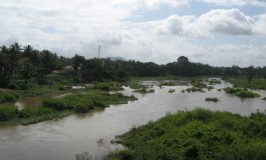
Bhadravathi town is situated in Karnataka and it is 255 Km from Bangalore. The town got its name due to the River Bhadra, which flows into town.
The Vasantha Vallbharaya Swamy Temple is situated on a small hillock in Vasanthapura layout in Bangalore city. This temple is 1,000 years old is dedicated to lord Srinivasa / Balaji / Vishnu and was built by the Cholas.
According to the story of the place, sage Mandavya Rishi installed the idol. The sage who was missing from his ashram situated on the banks of the Ganges was found meditating in a cave in Vasanthpura by his disciples.
The temple village Kailashpuri is situated 23 Kms from Udaipur, Rajasthan. The place has 108 temples and the 1200 years old temple of Sri Eklingji Prabhu / Lord Shiva is the biggest, oldest and most famous temple. The Aravalli hills and the forests form the perfect abode for the Lord.
Sri Eklingji is the family deity of Maharana / King of Mewar. Maharana Bappa Rawal built the temple in 734 A.D. and later was extended and maintained by the succeeding Maharana. Bappa Rawal was an ardent deity of the Lord and attributed all his success to Sri Eklingnath hence; the Maharana’s family considers Eklingji to be their family deity till date and also considers the lord as the king and the Maharana himself as the dewan (minister) of the state.
This ancient temple built in 1223–1224 by Polalva, a commander and minister of the Hoysala Empire King Vira Narasimha II is situated in Harihar / Harihara, Karnataka dedicated to Hari-hara / Lord Vishnu-Shiva. The beautiful 4 feet height idol is a powerful combination of the protector (Hara / Lord Vishnu) and the destroyer (Lord Shiva). The deity is also known as Shankarnarayana and Sambhu-Vishnu.This place is also known as Dakshina Kashi / Southern Kashi. On the right side of Harihara idol is carved Shiva’s trishul and the hair styled as an ascetic and on the left side Vishnu is carved with the discus and head is covered with a crown. This marvelous stone carved temple is visited by both Vaishnavaites and Shaivites.
God had to take this avatara / form because the places from Uchchangi Durga in the east, Govinahalu in the south, Mudanur in the west and Airani in the north were under the control of the demon Guhasura and the place was known as Guharanya. The demon had a boon from Brahma that no human or Shiva or Vishnu could kill him. This gave him the power and evil mind to harass people living around the place. When the people complained to the devas / gods about Guhasura, the gods in turn approached Vishnu and Shiva for a solution. Vishnu and Shiva came together in a new avatara called Hari – Hara (Harihara) and killed demon Guhasura. From then onwards, this place came to be known as Harihar. The place on earth where God took this avatar is near Kudalur, at the confluence of the rivers Haridra and Tungabhadra.
Lepakshi means “rise o bird” in Telugu and this place is situated in Ananthpur district of Andhra Pradesh. The legend says that Jatayu the mythical bird was injured by Ravana at this very place when it fought him to free Sita whom Ravana was abducting in his flying chariot. Hence the place came to be known as Lepakshi. It is one of the pilgrimage center of Shaivites / devotees of Shiva.
Picture1 – Lord Veerabhadra / Shiva and Goddess Durga / Parvathi
Lepakshi is famous for the ancient Veerabhadra / Lord Shiva temple, paintings and carvings in the temple.
Melukote is a famous piligrimage center situated in Mandya district, Karnataka. This place is also known as Thirunarayanapuram, Yadavagiri or Yadugiri nestled in the Cauvery river valley. From Mysore it is a 55 kilometers drive. As we drive from Mysore to the temple town, the scenery changes from lush green paddy fields to flat lands with rocky hills looming from either sides. A turn on a winding road up the hill into the town will surprise you with a beautiful clear lake glistening in the sun. It is an ideal spot for a picnic.
Two temples reside in this town, one on the foothills and the other on top of the hill. In the twelfth century the great Srivaishnava saint Ramanujacharya lived here for more than 14 years. These temples existed even before Sri Ramanujacharya came to this place.